Thursday, 6 March 2014

Job Specifications


Last week in Critical Studies, we began to look at job specifications and some of the skills required to obtain a job in the games industry. We discussed the difference between ‘soft’ and ‘hard’ skills, soft skills being communication and teamwork related and the latter being skills, related to specific software like 3DS Max and Photoshop. After this lecture I began to think more about my plans for the future and how to get there, I aim to create a road map detailing where I am now,  where I am going and what I need to do to get there. To start with I looked at various job listings for a few different positions, some because the position sounded interesting to me or because I was a fan of the development studio but finally I found one that ticked both of those boxes. Here is the listing:

Naughty Dog Environment Model & Layout Artist

Responsibilities
·         Create models and assemble scenes for both architectural and organic environments.
·         Trouble-shoot levels and maintain them to stay in frame rate, memory and design spec. 

Requirements and Skills
·         3+ years’ experience in games modelling environments using Maya, or related experience/software.
·         An exceptional understanding of form, shape, structure, and silhouette in regard to modelling
·         Strong experience and techniques in creating plants, shrubs and vines using cards/flats.  
·         Strong artistic ability to visualize entire levels and detail with minimal concept art and direction.
·         Strong technical ability to manage assets to fit memory, design, and frame rate limits.
·         Strong polygonal modelling skills- able to generate clean and efficient models at a very fast pace.
·         Self-motivated- requires minimal direction, can carry on the vision for the level until completion and commit to deadlines.
·         Good communication skills – able to help others and ask for help when needed. Being proactive in sharing info and assets.
·         Great team-player attitude - being flexible with new ideas, being open to direction and changes. Listening to team mates.
·         Deadline oriented- being able to manage and organize work so he meets all the deadlines and is able to adjust when changes happen.
·         Foundation in the traditional arts
 I chose this job listing because the job description best described the aspects I am enjoying most on my current university course and it is a company whose games I have played throughout my life. I’d say that all points listed under the responsibilities section and the first 6, along with the last point in the second section are all hard skills, skills relating to software and technical abilities and the rest would fall under the soft skills heading. I feel I have a very basic understanding of the responsibilities listed, the first one I have done a little of during my first year here at university although my knowledge is basic I feel I would adequately match this requirement by the end of my three year course. The second I know very little about, having built my own PC I know a bit about how it works; especially how games run but I feel this is tailored more towards how engines work which I have next to no knowledge of but I will have by the end of the course (hopefully). There is a fair bit on this list that I’d say at the minute I am nowhere near adequate enough with to get this job, with the exception of the some of the soft skills listed here ( which still needs some work, regardless, You can always build on soft skills) I’d say I really need to work on these over the next 2 and a half years.
The first thing listed under requirements is 3 years modelling experience, which I suppose I would have by the end of the course but I feel that I would need a couple of years in industry before I could really compete for a job like this one. I also think that I would benefit heavily from doing a placement while at university, it would give me approximately a years’ worth of experience that would help build on almost everything listed here. Something that I need to work on in my own time would be my time management, I need to plan more so I can efficiently get through my workload and I think that I should work on my social skills a little more and try to participate with discussions in class. All in all I think that after the three years of my university course come to an end I would tick all of these boxes; however I would probably be a little in-experienced. This sort of job would definitely be something to strive towards but I doubt I would be skilled enough to get this job post-graduation, I’d need a couple extra years in industry first.
Job Listing:
http://www.naughtydog.com/site/careers/environment_model_layout_artist/ 


Sunday, 2 February 2014

Week 18 - 3D Workshop

This week at university we had a 3D workshop that lasted the majority of the week, we were tasked with making a street scene in 3DS Max and texturing it.  We had no tri or texture limits but we had  had to make sure we were efficient and not make anything ridiculous like a 20,000 tri phonebox; everything had to be in proportion too so no 500 tri phoneboxes next to a 5000 tri dustbin. Initially the task did feel a little daunting especially on top of my other work but I definitely gave it 100% ( and barely slept) but the end result was pretty satisfying.  To begin with I modelled a phonebox, I mainly tried this as I had previously attempted it towards the start of the year and thought it would be good to compare; its safe to say i've improved. To be fair it was the start of the year so it was pretty terrible, the tri count was through the roof and the textures didn't line up what so ever but this attempt turned out to be a pretty realistic phonebox. I also decided to use previous assets I had modelled for various assessments to help build a realistic scene, with a little help laying it out from Google maps I managed to create an accurate street around my architecture project. During this week I also learnt a lot about rendering and the use of lighting which is something I had been guessing a lot in my previous work but I will definitely try to incorporate these techniques in my future work. I may also look in to external rendering software such as Marmoset Toolbag.

I do feel a lot more confident using 3DS Max now and I am lot more confident about the Transit van project I have been set that I will need to hand in next week. It has also pushed me to do 3D work in my spare time too like I would with visual design, perhaps modelling objects that I find interesting or that challenge me.


Saturday, 25 January 2014

Visual Design Intensive workshop week - Vehicle Design

This week at uni we were tasked with designing a vehicle based upon an interesting object of our choice, this is the first task we have been given that involves actually designing something so naturally I was a little apprehensive. We started off looking at the basic shapes that make up the object as a whole, we then moved on to look at silhouettes of the object and also of images from books; I mainly looked at birds and insects. We then used those those silhouettes to 'imagineer' a vehicle using marker pens and pads. We were also advised to try and solve a real world problem in some way, so i started to look at planes and the problems they encounter, my initial thoughts were to design a jet that could land vertically however i found that this does actually exist, the Harrier. I then saw that it can only generally land on flat surfaces so i started to look at something that could land on pretty much anything; so i looked at how insects land and stand up and began to draw up some designs. The design seemed to progressively get a little worse and more over the top but i then simplified it down a little and i was pretty happy with my final design. I really enjoyed this weeks work and enjoyed learning a new process, if i was to do it again i would of perhaps been a little more confident and bold with my designs and perhaps spent a little longer on the final. We also had our first digital painting tutorial which went pretty well (it made me want a Cintiq), before this course i had some experience with painting in Photoshop however that was all self taught so it was good to actually be taught how to use it properly. The final turned out pretty well and definitely shows my idea clearly, whilst its not perfect its not bad for the first piece of digital work I've done on this course.

My final Piece for the vehicle design project based on my computer mouse

The course so far...

I've been studying Game Art at DMU for around 4 months and I feel now is a good time to reflect on the course so far. In a nutshell I'm really enjoying it and from what I've heard the course is only going to get more interesting but also more difficult. The work load grows each week but Im yet to feel like its getting on top of me, don't get me wrong I'm up late most nights doing work but that's mostly out of choice. We had an assessment just before Christmas which went surprisingly, well to say that a lot of people have been told to re-do pretty much everything. I did have to re-submit my 3D building project as I had basically messed up some of the texturing which was pretty fair; I know to read the brief a bit better now. Whilst doing this i found it took around half the time to put together in comparison to before and i utilised my texture budget a lot more effectively. 
I was told that if i was to hand my work in as it is I would get a pass grade, which from what I've heard of other peoples assessments, is pretty good. However I was told I could bump my grade up by doing a list of certain tasks, including re-doing all my finals in an A3 sketchbook, clean up all my work on facebook, clean up my sketchbook and fix drawings with hairspray. I would say I've learnt more in these past few months than i have in the past few years and I definitely think drawing comes more naturally to me now and I don't quite have to think about it as much as I did. I do now feel like I should perhaps do something a bit more productive with the little free time I have, do some personal work or masters studies or maybe learn some basic coding skills; especially after the talk we had a couple days back from an Indie game dev, i felt quite inspired to attempt my own game to better understand the process. After the assessment i feel a little more confident in what i have to improve to further my drawings, I need to stop feathering my lines in as it shows the viewer i'm not confident in what i'm drawing. Instead i will try to work a little lighter to begin with and then define my line-work a little heavier afterwards. My tutors also hinted that i may need to look at my composition abit more. Im currently looking alot at using only tone and very minimal line work to show shape and form as it helps build a visual understanding of the object in front of you without worrying about the linework surrounding it.


A quick before and after of one of my finals after re-doing it in A3 over christmas.

Wednesday, 20 November 2013

Defining A Genre (personal enquiry draft 1 - research)

I think the diversity of the genres that have popped up over the the years are one of the more important occurrences. This is also very much linked with the technological limitations at the time, gaming had to reach a certain point before a lot of games were even possible. I decided to research in to various games that I initially consider to be the first of their kind, upon researching them I found this not to be true however the games I did choose are considered by many to be the defining games of each genre. These are games that are the first to include certain conventions that have since been in most games of that genre since, conventions such as the alarm phases or the lack of weapons in Metal Gear to the lack of health items and ammunition in Resident Evil.

I would like to go into a lot more detail on one of these games, talking about how it established genres as we know them and why the game is important. The genres that made the biggest impact out of the ones I researched are the FPS, Stealth and Survival horror genre. Out of the three games in those genres I chose I've only played Metal Gear solid and Resident evil. So I will more than likely elaborate on one of these. Metal gear added a lot to stealth in 1998 and continues to add to it now with new innovative mechanics each game, the success of Metal Gear Solid, which sold over six million copies, was crucial to popularising the stealth genre, and in the years that followed, stealth-based game-play became a feather in the cap of a number of different series. Splinter Cell and Assassin’ s Creed were exponents of heavily stealth-orientated play. Resident evil also another game where its conventions carry forward in to other games and established our understanding of survival horror. It took a genre and reshaped it in to a new one, which added a great sense of realism and a lot more tension. Whilst the voice acting was terrible it was probably one of the best games on the PlayStation. Now however this franchise has fell a bit flat, whilst Resident Evil 4 felt like a fresh re-imagining of resident evil, 5 and 6 became to action orientated and have slightly lost what made them great in the early days. 


References:
http://en.wikipedia.org/wiki/Video_game_genres
http://uk.ign.com/articles/2009/10/30/ign-presents-the-history-of-survival-horror?page=4
http://www.youtube.com/watch?v=pXqpAIUZbZo
http://www.gamesradar.com/the-sneaky-history-of-stealth-games/

Tuesday, 12 November 2013

Gaming history -1980s-90s


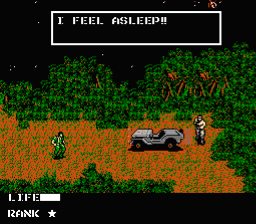
Huh?! What was that noise?

These two decades are considered to be some of the most important so far due to the innovation that occurred during them and how they spawned the infamous "console war" which still rages today. From "blast processing" to the creation of handheld system, the 80s saw leaps and bounds in technological advances. Which meant as technology progressed games were always at the cutting edge. Some of my earliest gaming memories include playing Streets of Rage on the Mega Drive, this being one of my first experiences of video games, I look back on it now and question how good it actually is, is it just nostalgic to me now? But in its time it was considered one of the best games on the system and is popular among many gamers.

It wasn't all fun and games for the industry in the 80s towards the start of the decade sales of games and consoles began to slump due to over saturation of the market. There was a massive recession in 1983, revenues that were previously at 3.2 billion fell to 100 million. It was caused by a variety of things but the main cause was over-saturation. Nintendo however managed to rescue it, with its Nintendo Entertainment System in 1984. Launched in Japan a year before as the Nintendo Famicom, its massive popularity made Nintendo see the potential of this console and decided to market it in North America. Nintendo did originally plan to market the console with the company Atari however after some debates about licensing Nintendo decided to market it on its own. Another big thing that came out of the early 80s is more diversity in game styles and genre, this is something that has constantly expanded since the 80s. Action, RPG, beat em up, hack and slash and platformers all come from the 80s. Games like The Legend of Zelda and Metal gear helped established genres in the 80s and still continue to develop the genre and new games in the series today.

A sample of the quality of NES games, amazing at the time but not so much anymore. (Metal Gear)


The next and probably most important innovation of the late 80s is the arrival of the gameboy. Its younger colour sibling was the first console I personally owned and never really put down for the next 5 years. It offered amazing NES like 8-bit cpu graphics on the go, if you could live with the cost of batteries and the inability to see the screen it was fantastic. Its success greatly depended on the game Tetris which was released soon after launch and massively boosted sales. This was the creation of an all new type of games console. The next couple years saw the a considerable improvement graphics wise with the release of the Sega Mega Drive and soon after the SNES (Super Nintendo Entertainment System) which offered colour realistic Graphics and rich colours. Then in 1995/6 the playstation and N64 were released which ushered in the era of 32- bit gaming, offering colourful animated 3D games with "realistic textures". We also owned a PS1, i remember playing Tomb Raider and not being able to get past the first level for hours. In fact one of my all time favourite games, Metal Gear Solid, is on the PS1. The machines internals allowed for a cinematic movie like experience, with real voice acting which made for meaningful stories. The level of detail and scale also increased and allowed for more of an artistic license with character and environment design.

Along side the rise of the console the pc always remained ever so slightly ahead, following the success of the oh so useful Apple 2(see below) in the 70s, personal computer power grew a lot through the 80s. Whilst PCs were much more powerful in comparison to consoles but this also meant they were A LOT more expensive as consoles were aimed more at families and young people. 1993 saw the release of one of the first FPS games, Doom 3D which was also one of the first 3D games. Games also came on CD-ROM disks which allowed for a lot more storage in comparison to ROM cartridges. In the late 90s the pc also saw the release of the classic pc game, Unreal Tournament which was praised heavily for its Bot AI and is also one of the first games to integrate online play across the internet. In the next decade comes the consoles we know very well, consoles that include full HD realistic graphics, gameplay and online play is taken for granted by many. I shall continue this in the next blog post.


In the start of this TED talk, Maeda discusses what the Apple 2, a revoloutionary piece of tech can actually do

References:
http://www.ted.com/talks/john_maeda_how_art_technology_and_design_inform_creative_leaders.html?utm_source=email&source=email&utm_medium=social&utm_campaign=ios-share - Ted Talk
http://www.consoleclassix.com/info_img/Metal_Gear_NES_ScreenShot3.gif - Metal gear Pic
http://content.time.com/time/interactive/0,31813,2029221,00.html
http://en.wikipedia.org/wiki/History_of_video_games#Golden_age_of_video_arcade_games_.281978.E2.80.931986.29
http://www.nintendo.co.uk/Corporate/Nintendo-History/Game-Boy/Game-Boy-627031.html
http://www.classicgaming.com/features/articles/computergaminghistory/
http://en.wikipedia.org/wiki/Sega_Genesis
http://www.geeksquad.co.uk/articles/gaming/2012/07/the_history_of_pc_gaming


Friday, 1 November 2013

A history of Computer Games part I: A history of computers - 1970s

Why do we play games? Why did we start to make and play games? For entertainment purposes... Right?

These were the questions I found myself asking after my recent lectures on the history of computers, common sense would tell you they are and were made for fun however initially that's not necessarily true, the first ever game was in fact made to demonstrate the hardware developed for a laboratory annual exposition by a scientist that also worked on nuclear weapons. The game was tennis for two and was created by William Higinbotham and took a few weeks to create. From this point onwards it was more recognised as a form of entertainment and was seen as something that could potentially become profitable however things were quite slow until the 70s. This is later proven by the boom in different consoles in the 80s but ill go in to detail on this in a later blog post.

The Jacquard Loom built in 1801 was considered one of the first steps towards modern computing, it was able to produce different patterns by inserting different cards with holes in it. Although the loom did no computation based on them it was it was considered a conceptual precursor to computer programming. Another major step in computing was the difference engine, it is essentially the first attempt at the calculator. This was more of a concept as it was never actually built due to needing very precise parts which could not be produced at the time but it has been built since and has been proven to work. It is also one of the first examples of input and output as it would punch the results in to a piece of paper afterwards.
Here is an example of a Jacquard Loom and the hole-punched paper output i mentioned.

If you were to do a quick internet search for women in technology you wouldn't find too much. Very rarely do stories of women in the tech business vary from people saying "where are the women?".Women in fact helped pioneer technology as much as men did, An example of this is Ada Lovelace. She directly helped create the first computer and through her notes she is recognised as the first computer programmer.

Here is the game Tennis for two running on its original machine, you also saw the device used to control it which is potentially the first ever control pad

From a young age we had a computer, I vaguely remember only being able to use it after 6pm due to the dial up connection however at other times I remember playing Command and Conquer for hours on end. This was probably my first experience with gaming other than my brothers Sega Mega Drive. Computers, are something we have taken for granted for many years now, our generation has grown up with them and they will continue to be integrated in to society more as companies and designers innovate. Computers have been around for hundreds of years however its not until the 1950s that technology started to become powerful enough to run basic games and the know-how to produce said games came about. This brings us back to Tennis For Two which was first introduced in 1958 created at the Brookhaven National Laboratory.

Probably one of the biggest advancement in technology in the past few hundred years is the Cathode Ray Tube or CRT display which first came around in 1897 and has been adapted and perfected over the years. In 1947 the first interactive electronic game using a CRT screen was created by Thomas T. Goldsmith Jr and Estle Ray Mann. This was the first recorded interactive electronic game although this is argued. It was never marketed or released to the public but was patented in 1948. This was considered one of the biggest steps toward arcade and home gaming. As mentioned earlier, the first video game was created in 1958 by William Higinbotham and was called Tennis for Two, it was played on a Brookhaven National Laboratory oscilloscope. Many adaptations of this game and other attempts at sports based games came from this also but this then led to another notable game, Spacewar, made in 1962 and is the first game to be based off something that doesn't actually exist. This then essentially became the first arcade game later in 1971 and was then followed by the arcade version of pong a year later, this year also marked the creation of Atari. Four years later pong was released for home consoles. The first ever video game console you could plug in to the television was the Magnavox Odessey By many pong is considered to be the first game to be created however this is a common misconception, this is just one of the first few games to be released on console. At this point games and gaming consoles began to look more recognisable with handheld devices to control it and the ability to plug it into the tv.

The golden age of gaming soon follows however i will continue this in a future blog post.
Image,Video reference:
http://www.youtube.com/watch?v=6PG2mdU_i8k - Tennis for two video
http://upload.wikimedia.org/wikipedia/commons/b/b6/Jacquard_loom_p1040320.jpg Jacquard loom picture
http://phandroid.com/2012/02/10/relive-the-golden-age-of-gaming-with-cpsemu-cps2-emulator-for-android/ 80s games image
http://www.youtube.com/watch?v=O4dPSOncwVQ - A cheesey American documentary that proved rather helpful


General Reference:
http://www.theverge.com/2013/1/16/3740422/the-life-and-death-of-the-american-arcade-for-amusement-only
http://classicgames.about.com/od/history/tp/HistoricWomeninClassicGames.htm
http://en.wikipedia.org/wiki/Tennis_for_Two
http://www.bnl.gov/about/history/firstvideo.php
http://www.ideafinder.com/history/inventions/jacquard.htm
http://en.wikipedia.org/wiki/Jacquard_loom
https://www.atariage.com/
http://classicgames.about.com/od/classicvideogames101/p/CathodeDevice.htm